The illusion of independent judgment in AI.
Every hurricane season, the same two pictures appear on the news. The first is the spaghetti plot: a dozen or more thin lines fanning out across the Gulf or the Atlantic, each one a projected path for the storm’s center. The second is the cone, that familiar white funnel widening from the storm’s present position toward the coast. Millions of people study these images and make real decisions based on them: board the windows, book the hotel inland, stay put.
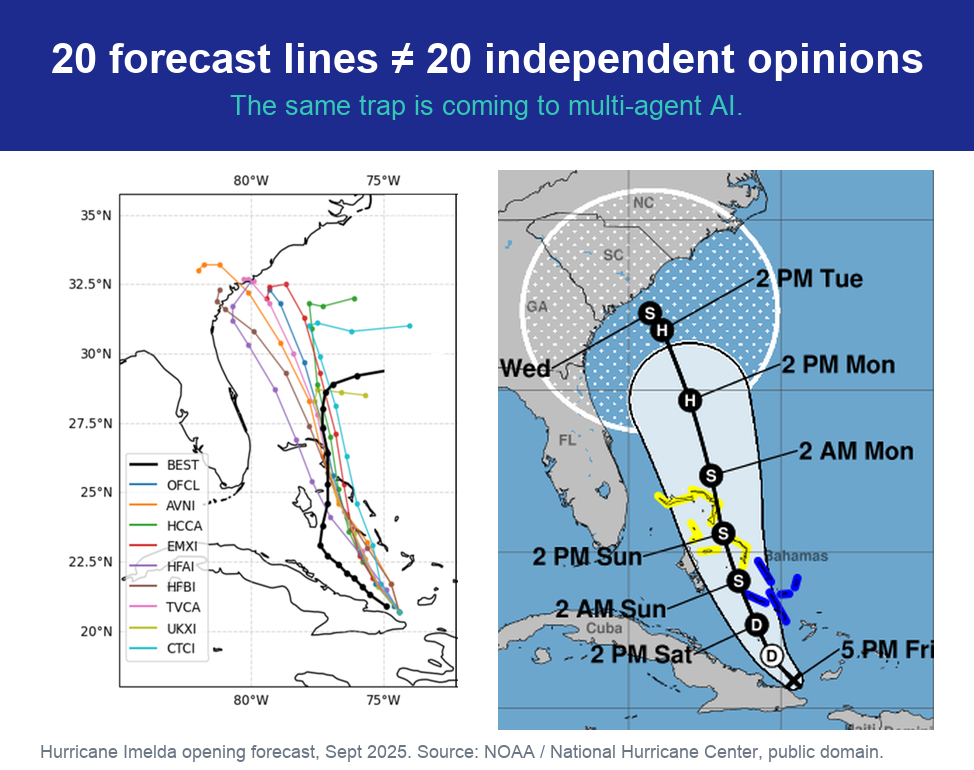
Independent models on the left; the single official National Hurricane Center cone on the right.
I ended the last piece by promising that the most familiar picture of reliable prediction appears on the news every hurricane season, and that almost no one realizes they are looking at Condorcet’s theorem in action. That is true. But many people misread these two pictures, and what they actually show is worth a closer look.
The much-misunderstood cone
Here is what the cone is not. It is not a consensus. It is not a vote among models. It is not a jury.
The National Hurricane Center draws the cone around a single official forecast track, and it sizes the cone statistically: the circles are set so that two-thirds of the prior five years’ official track-forecast errors fall within them. In the Atlantic, those circles start at roughly 25 nautical miles at 12 hours and grow to roughly 200 nautical miles at 120 hours. Read that definition again and notice what it implies. The storm’s center is expected to stray outside the cone about one time in three. The cone is a calibrated error band around one answer, an honest admission of how wrong the official track has historically been, not an aggregation of many answers. That honesty is a strength. It is the opposite of false confidence, and false confidence is the failure the rest of this piece is about.
The spaghetti plot is closer to a jury, but it hides a trap. Those lines show only track, where the center might go, and nothing about wind, surge, or rain. More importantly, the lines are not all the same kind of thing. Some are genuinely different models built by different institutions on different physics and code: GFS, ECMWF, UKMET. Others are many perturbed members of a single model, such as the members of GEFS, which share one model’s assumptions and one model’s biases. When twenty lines from a single-model ensemble bunch together, that agreement can be false confidence. They are not twenty independent jurors. They are one juror’s opinion, photocopied with slight smudges.
That distinction is Condorcet’s 1785 result in a single image. If each juror is more likely right than wrong, and the jurors vote independently, then adding jurors drives the majority’s chance of being right toward certainty. It is why we convene a jury, rather than trust a single authority, when the stakes are high: many independent judgments, combined, beat any one of them. The key word is independently. Correlated voices do not multiply away error. They amplify a shared mistake.
So the popular picture is imperfect, and that is exactly why it is the right place to start. Hurricane forecasting is the one arena where the public can actually see, side by side, the difference between an error band, a set of correlated copies, and genuinely independent models. The forecasters know the difference. The rest of us should too, because the same distinction now decides whether AI systems can be trusted. What follows are examples of getting it right, each more independent than the last, starting with the weather.
When two different machines beat either one
The forecasters have started acting on it. In December 2025, NOAA operationalized HGEFS as part of Project EAGLE. It is a 62-member “grand ensemble” that fuses a 31-member AI-based ensemble, AIGEFS, with the 31-member physics-based GEFSv12. An AI model learns from data; a physics model integrates equations. Their errors come from structurally different places, which means they are partly decorrelated, which means combining them is not just averaging more of the same opinion.
NOAA’s release reports that in initial testing HGEFS consistently outperformed both the AI-only system and the physics-only system, winning across most major verification metrics. Two caveats belong on the record. That is initial testing and “most” metrics, not a settled peer-reviewed result. And the performance claim is NOAA’s own, reported at deployment rather than confirmed by a third party, which is a little ironic in a piece about independent verification. The independence is partial too, since the AI model was trained on data that ultimately flows from the same observation and physics pipeline. But the direction of the result is the point: two systems with different failure modes, fused, beat either alone. Two systems that fail in different ways beat any one you simply trust.
The independent second reader
Medicine institutionalized this idea long before AI arrived. The UK’s breast-screening standard is double reading: two readers examine each mammogram independently, and when they disagree, a human arbiter decides. It is a two-person jury with a tiebreaker, built on the assumption that two independent readings catch what one misses.
In March 2026, Nature Cancer published a retrospective study of 45,602 women across two NHS breast-screening centres in London that asked what happens when an AI takes the second reader’s chair. The answer was careful and instructive. With AI as the independent second reader and a human still arbitrating disagreements, the workflow was non-inferior to two human readers on sensitivity and specificity, while cutting human reading workload by roughly 46 percent. Cancer detection did not significantly improve; the honest claim is that reliability held while nearly half the human reading effort was freed. It was retrospective, at two centres, not a randomized trial and not a national dataset. But the structure is the story. The AI did not replace judgment. It took the second reader’s seat in a process built on independence and a human tiebreaker, and the process held.
The outside grader
Stronger still is the outside grader, a checker with no stake in the answer. Waymo published its own safety studies for years. Then, in July 2026, the Insurance Institute for Highway Safety, a nonprofit funded by auto insurers and not by Waymo, ran the numbers itself, with its own method and its own human-driver baseline, across about 50 million driverless miles. It found Waymo’s cars in 68 percent fewer police-reportable crashes per mile than human drivers.
That is the point of an outside grader. The company can publish whatever it likes, but the verdict that counts comes from a party with nothing at stake. IIHS was careful about the limits, and one matters most: some of the underlying crash data still comes from Waymo’s own required filings, so the independence is in the analysis, not fully in the raw data. A grader that admits the limits of its own independence is still worth far more than a company that grades itself and claims none.
Separate by design
The sharpest version of the idea is not an outside firm at all, but a checker built to be structurally separate from the start, inside the same organization. NASA learned that lesson in spaceflight, where a missed flaw can cost a mission. Software checked only by the team that wrote it is correlated self-checking: the same assumptions that produced a flaw are the ones least able to see it. So for its most safety-critical missions, NASA does not let the builders certify their own code. It runs a dedicated Independent Verification and Validation program, at the Katherine Johnson IV&V Facility in West Virginia, that examines flight software from outside the chain that produced it and answers to a different authority than the developers.
The design principle is the whole point, and it is the one worth carrying into AI. Verification that reports to the thing it verifies is not verification. To be worth anything, a checker has to be able to say no and have that no count, which means it cannot answer to the people whose work it is checking. That is not bureaucracy. It is the difference between a safeguard and a rubber stamp.
When 90% and 90% make 99%
The math is simple. Suppose a generator is right 90 percent of the time, and suppose an independent checker catches 90 percent of the generator’s mistakes. Because the checker’s errors are uncorrelated with the generator’s, the error rates multiply rather than add: a generator wrong 10 percent of the time, paired with a checker that misses 10 percent of those mistakes, is wrong and uncaught on only about 1 percent of its answers. That is not a measured result from any study. It is the arithmetic of independence, and it rests on two assumptions. The checker must be strong, with few false alarms. And the checker must be independent. Let the checker share the generator’s training data, its incentives, or its management chain, and the multiplication collapses back toward self-confirmation. Combining forecasts and checking answers use different math, one averages independent errors down, the other multiplies them away, but both work for the same reason: independence.
This is the same principle as Condorcet’s jurors, and the same reason every failure in the first piece happened the way it did. Science has run on this principle longer than any of us: a result is not trusted until a physically separate experiment, run by someone else, reproduces it.
The examples that work all share one structural feature. The forecast, the mammogram, the robotaxi study, the flight software: in every one, what makes the check real is not the brilliance of the checker. It is the separation.
The failures cataloged in the first piece all share the opposite feature: a confident output, and no structurally independent check between that output and the world.
We do not need to invent the answer. We have had it since 1785, and we watch it on the news every hurricane season. A jury is reliable because its members are independent, not because any one of them is brilliant. Build the independent juror, keep it independent, and unreliable parts become a reliable system.
Which is worth sitting with as we wire AI to check its own work. If your generator, your critic, and your judge all descend from the same foundation model, do you really have three independent checks, or just one?
Because you cannot grade your own exam. And neither can your AI.
This is the second piece of a two-part series; the first, A Jury of One, lays out the cost of skipping independent verification, and this one turns to the answer. Both accompany the NeoVerity whitepaper You Cannot Grade Your Own Exam: Why Physical AI Needs Independent Verification, which develops the argument in full.
Sources
- National Hurricane Center, “About the Cone of Uncertainty”: nhc.noaa.gov/aboutcone.shtml
- NOAA, “NOAA deploys new generation of AI-driven global weather models” (Dec 17 2025): noaa.gov
- Nature Cancer, “Impact of using artificial intelligence as a second reader in breast screening including arbitration” (Mar 2026): nature.com
- IIHS, “Waymo’s driverless cars crash less often than people” (Jul 23 2026): iihs.org
- NASA, Independent Verification and Validation (IV&V) Program: nasa.gov/ivv